So, after a little hesitation, Labour voted against the fiscal charter. Well, when I say 'Labour', I mean 'all but twenty Labour MPs'. And those who heroically abstained did so, not because they thought the fiscal charter - committing British governments to obtain a a budget surplus by 2019 and maintain it subsequently unless GDP growth falls below 1% - is a good idea, but in order to have a pop at McDonnell and Corbyn.
It is, after all, manifestly obvious that the charter is not a good idea. In order to recognise this, you don't need to be a signed up adherent of any specific school of economic thought . In particular, you don't need to buy into the 'Keynesianism' attributed to McDonnell by some of his leftist critics, a doctrine whose relationship to anything Keynes actually said is decidedly minimal. No, to take this view, you just need to think that it's sometimes handy for governments to be able to borrow outside the terms dictated by the charter. You could think this for any number of reasons: deep or shallow, right or left. Thus, for example, the wide-eyed Trotskyists at The Economist. Or, for that matter, some character called George Osborne. To be honest, you don't even need this level of justification for rejecting the charter: the simple empirical observation that governments have borrowed far more freely than the charter allows without the sky caving in ought to suffice.
Now, George Osborne knows all of this. He does not, for one moment, think it is either possible or desirable for a government to abide by the terms of his charter. To understand why he brought it to the floor of parliament, we need to see that it is about politics, not economics. Or rather, it is about economics as politics. He knows that a section of voters think Labour is 'weak' on 'the economy'. Hence all the rhetoric about Corbyn being a 'threat to your family's economic security', and hence the charter, which is designed to mark out the Tories as the tough, responsible, party who can be trusted with 'the economy'. Quite why someone struggling to make ends meet should care much about some abstraction called 'the economy' may not be apparent, but this is where a powerful analogy kicks in.
Government accounts, for this analogy, are our household budget. And, as the less than feminist Margaret Thatcher put it, 'every housewife knows' you can't spend more than you earn. Even as an approach to personal budgets this is simplistic at best. It's an image born in a time before mass consumer credit and student loans, one of the insufficiently told stories about debt in advanced capitalist societies being the extent to which it has shifted from the public to the personal. But as a picture for government borrowing and spending it is grotesquely misleading. Still, it is powerful: not only simple, but comforting, it ties the abstract and economic to the homely and familiar, speaking of collective responsibility (being 'responsible' with 'our' finances) in a world that can seem both atomised and amoral. It is ideology in its pure, brilliant, form.
And the picture has captured hearts and minds. I've lost count of the number of conversations I have had where the household analogy has been flung back at me when I've opposed cuts or one sort or another. This audience member on Question Time is a good example of the phenomenon:
Varoufakis is obviously correct; his answer is quite literally a textbook one. But I doubt very much that the questioner was convinced, and I'm not too sure about viewers at home, beyond the echo chamber of the already-converted Left, who shared the video clip with gleeful abandon on every social media website known to humankind. The man is speaking common sense, which is one way of describing successful ideology. Varoufakis is speaking economics.
The function of the household analogy is not so much as to build up support for near-perpetual budget surpluses - I've said already that this is not Osborne's purpose - but to render a section of the population suspicious of public spending, and to thereby gain consent for the dismantling of collective provision, privatisation and welfare cuts.
The household analogy is not the only manner in which an image, picture, or cluster of ideas serves to reconcile people to economic attack in Cameron's Britain. Think of the what has been called the business ontology, the way so many of us view the world as one big interplay of consumers and individual entrepeneurs (rather than as, say, a site of conflict between workers and capital). The language of entrepeneurship is endemic: what might once have been thought of as terrifyingly insecure short term work might now be presented as an opportunity to advance one's CV in the cause of career entrepeneurship. Then consider all those television programmes inviting us to view our homes as investments (rather than, for example, shelters), and murmuring suggestively that we too might make big on the property market.
This stuff is long-standing and deep-seated. Unless and until the Left can establish some kind of counter-hegemony, a socialist common sense as well-entrenched as that visible in the wide grin of the Question Time inquisitor, until we can communicate clear and attractive accounts of the world to rival that of it as one big market place, we will not make progress. We can have all the correct arguments about the economy we like. We can explain how Osborne's policies are wrong, as indeed they are. We can even make the case that capitalism itself is a barrier to human flourishing, as indeed it is. But politics is about more than arguments, however much those of us who are most at home in the world of facts and figures might wish otherwise. It is about pictures, broad-brush ideas, hopes, fears, and dreams. As any housewife knows.
Saturday, 17 October 2015

Sunday, 11 October 2015
The task that remains
...the whole history of the Labour Party has been punctuated by verbal victories of the Labour Left which with some few exceptions, have had little impact on the Labour Party's conduct inside or outside the House of Commons, but which have always been of great importance in keeping up the hopes and the morale of the activists
Ralph Miliband - Parliamentary Socialism
Miliband was writing in 1961. Little that has happened since gives us cause to question his account of the Labour Left's victories being pyrrhic affairs. The dust has now settled since Jeremy Corbyn's triumph in the leadership election. It is time to ask the hard question: will the election of the most left-wing leader in the Party's history buck the trend of purely nominal high-points for the Left? Or will something of lasting value come out of it? What could that even be?

False hope is a subtle enemy, so let's start by coming down to earth. Things do not look good. The fundamentals haven't changed since May's election defeat: there is not an automatic mass audience out there for the ideas on which Jeremy won the leadership. It simply isn't the case that Labour voters will automatically flock back to the Party now it has a 'proper Labour' person in charge (of course, with a nod to the elder Miliband, we should insist that Corbyn isn't a proper Labour leader; he's much better than that). We need to win the battle of ideas, and that's a job of work. Still less will Corbyn solve Labour's Scottish problem: indeed, the saddening truth is that his attitude towards Scotland has been unionist business-as-usual, an approach which fails to understand either the scale of what happened north of the Border, or the reasons that it happened.
Winning the contest of ideas is not easily done with a substantial proportion of the PLP openly hostile to varying degrees towards Corbyn. Senior MPs are regularly briefing against him, and front-benchers are distancing themselves from policies like nuclear disarmament. The plan is clearly to replace Jeremy as leader before the 2020 general election: I think it's likely the knives will come out as early as next year. Meanwhile, CLPs remain largely in the hands of the right - Corbyn may have won the leadership, his opponents control the party. True, there are thousands of new members who joined to vote for him. But even assuming that their politics are uniformly of the left - a dangerous assumption, I think - they are in the main inexperienced in Labour politics, and their resolve to fight the often brutal, and more often dull, battles that will be a feature of Party life over the next few years is untested. Certainly the failure of Diane Abbott to win the London mayoral candidacy and of the left slate to get elected to the Conference Arrangements Committee shows that we can't simply assume that intra-Party politics will now shift left.
So, two questions. What those on the socialist left of Labour expect from the Corbyn leadership? And how do we go about getting it? Three bullet points in answer to each
- Jeremy for PM! It may be a dream, but it's good to dream, and even better to fight for our dreams. A government based around Corbyn's programme, whilst it would meet with determined resistance from day one, would have great potential to improve the lives of the majority of people in Britain, and to provide a fertile ground for socialism.
- Developing a movement and ideas. The surge of support for Jeremy is a potential new activist base, which could be the foundation of a left movement for the next generation. The established Left can, and should, both learn from it and feed in socialist ideas born through political experience.
- ...which interacts with struggles outside parliament I do not think capitalism can be overcome by parliamentary action alone (there is a danger, which we have to acknowledge, that Corbyn's victory could fuel this illusion). So it's vital that the Corbyn surge feeds back into struggles outside parliament, in workplaces and communities.
Those are the things I think we should aim for. How to get them?
- Get involved in the Party Whether old or new members, we all need to get active in our local Labour Party, support Left candidates in internal elections, and argue for the policies on which Jeremy won. If you're new to the Party, learn about how it works. Join a trade union if you're not a member: unions are crucial to Labour's life, and to the defence of your rights. Subscribe to Labour Briefing which carries, from a Left perspective, news about what's happening inside the Party and how to get involved. Whilst I have concerns about its seemingly top-down nature, I also think it's worth being involved in Momentum, and seeing how it develops.
- Political education The established Left within the Party has to get its act together quickly on this one. We can't lose the new support. In an open and non-patronising way, we urgently need to communicate the nuts and bolts of Labour Party politics as well as putting across our ideas about socialism.
- Don't ignore extra-parliamentary action. The focus on the Labour Party can't be at the expense of action outside parliament. In particular, the government's attack on trade unions has to be met.
Let's get cracking.
Saturday, 12 September 2015
Don't organise, celebrate
If, like me, you think today's leadership result is fantastic news, do spare a thought for Alistair Campbell. He's clearly a little upset:
Other prime examples of the throwing-the-toys-out-of the pram genre were forthcoming today from Dan Hodges here and the New Statesperson here. The latter is notable for its attempt to claim the mantle of feminism for its opposition to the only leadership candidate to have voted against benefit cuts which disproportionately affect women, and who secured the votes of 61% of women who voted. One notes in passing that the NS's commitment to the political representation of non-white non-men wasn't quite fervent enough to get the organ's weight behind Diane Abbott's mayoral campaign.
But, enough. It is not only a good day because lots of really terrible human beings are upset. We also have a leader of the Labour Party who can make speeches that don't make me cringe:
And does stuff like support refugees:
I wrote after the general election about my dislike of the slogan "don't mourn organise". The converse, "don't celebrate, organise" is no better. Tonight we celebrate. In the days, weeks, and months ahead the issues I wrote about then - not least the neo-liberal hegemony which still has an absolutely stranglehold over British society - will need thought and action. There are fights ahead, within and beyond the Labour Party; there is a battle of ideas to be won. But tonight, I'll end by saying that this is the best day in my political memory. We won.
@OwenJones84 come back after you've won a few general elections and start lecturing about winning. Enjoy your evening
— Alastair Campbell (@campbellclaret) September 12, 2015
This, in general, seems to be the strategy of Labour's hard right: repeating, mantra-like and with an air of genuine incomprehension, "but, but.. we won in 1997". A problem with this approach is that 1997 was a long time ago. Campbell and his soundalikes are really the political equivalent of someone who insists that we recognise that Genesis' Nursery Crimes was a pretty good album, without even pausing to acknowledge the subsequent attrocities of Phil Collins' solo career.Other prime examples of the throwing-the-toys-out-of the pram genre were forthcoming today from Dan Hodges here and the New Statesperson here. The latter is notable for its attempt to claim the mantle of feminism for its opposition to the only leadership candidate to have voted against benefit cuts which disproportionately affect women, and who secured the votes of 61% of women who voted. One notes in passing that the NS's commitment to the political representation of non-white non-men wasn't quite fervent enough to get the organ's weight behind Diane Abbott's mayoral campaign.
But, enough. It is not only a good day because lots of really terrible human beings are upset. We also have a leader of the Labour Party who can make speeches that don't make me cringe:
And does stuff like support refugees:
I wrote after the general election about my dislike of the slogan "don't mourn organise". The converse, "don't celebrate, organise" is no better. Tonight we celebrate. In the days, weeks, and months ahead the issues I wrote about then - not least the neo-liberal hegemony which still has an absolutely stranglehold over British society - will need thought and action. There are fights ahead, within and beyond the Labour Party; there is a battle of ideas to be won. But tonight, I'll end by saying that this is the best day in my political memory. We won.
Thursday, 27 August 2015
Take off the tinfoil hat

Sometimes I wish the world was run by a secretive elite. If it was, it would be a lot more interesting than it in fact is. There is a certain romance in believing one is facing down Bond-villains, nestled away in shadowy bunkers, in which they feed disloyal acolytes to crocodiles. This romance is lacking in Michael Gove. In fact not a single one of the British ruling class lives up to the standards of proper archetypical evil. They don't have lairs, they have villas in Tuscany. And not one of them has ever bitten the head off a live chicken. Although at a push Prince Philip has done this to a swan. We are, alas, doomed to mediocre malice in our rulers.
Nor, it has to be said, are this crowd especially secretive. Take the Conservative Party. They stood for election saying that they were going to impose massive cuts and attack trade unions. And having won the election they are proceeding to do just that. They may be bastards, but they are not sneaky bastards by any stretch of the imagination.
Perhaps it is a desire for a bit of excitement that drives 25% per cent of Corbyn supporters to believe that, contrary to fact, the world is run by a secretive elite. Like crazed lefty adrenaline junkies that these comrades of mine clearly are not content with nationalising the railways; they hope that they have to fight the CIA-Zionist-Lizards to do so. I'll come back to the 'Zionist' bit of that, since there's a darker side to all this conspiracy theory stuff.
'Conspiracy theory' - that's right. A striking feature of the 21st century left, which no doubt reflects a wider trend in our society, is the prevalence of so much conspiracy theoretic murk. I challenge you to go to more than a couple of demos without encountering some excitable character in a Guy Fawkes mask talking about the New World Order. If you're lucky, they might hand you a typewritten leaflet all about it. More mainstream, but in perpetual danger of slippage into conspiracy-talk, is the idea that there is an all-pervasive thing called 'the establishment' - the category, popularised by Owen Jones, has all but replaced the older, more nuanced, language of class and the state on much of the broad left. Put 'the establishment' together with an emotive topic like paedophilia, as recent news stories have done, and the crowd go wild - the number of supposed 'revelations' on this topic I've seen shared on left-wing social media is genuinely disturbing. Meanwhile the near-paranoid sense that everything is done with an ulterior motive has led numerous people to know better to support Julian Assange's attempt to avoid rape charges, on the basis that 'they' are out to get him. Indeed, the popularity of Wikileaks on the left -- the project in fact has its origins in the libertarian right -- is largely owing to the desire to know what they are hiding from us.
The striking reality of capitalist society, on contrary, is that everything is done in the open. I'm not denying, of course, the sordid reality of secret police forces and backroom deals. But the basic business of exploitation, the key structural features of the kind of society we inhabit: it's all out there in the open for everyone to see. The world is run for profit and proudly wears that fact on its sleeves, even as CEOs and Prime Ministers alike speak aloud about the need to reduce labour costs. In as much as this world is sustained by illusions, they are remarkably egalitarian illusions. The CEO and the bond trader, just as much as the shop worker and the pensioner, invest markets, currencies, and other creatures of our making, with an agency independent of the humanity that fashioned them. If you like, the system itself produces the illusions. The only secret is that there is nobody pulling the strings: we are not dealing with puppets, but with automata. The upside to this sorry state of affairs is that we are capable of distancing ourselves from it and stating the truth of the matter. As I just did.
That last paragraph is a standard old-fashioned leftist response to conspiracy theory. Why does it no longer convince a good number of people on the left? Partly, I think because, contemporary capitalist societies move at such a dizzying pace that peoples' experience of their lives is utterly disorientated and piecemeal -- the idea that 'They' are behind it all can be oddly comforting in such circumstances: there is an ultimate order and purpose, even if it is hostile. The Lizards are a Calvinist God for an unbelieving age.
Then there's the spectacular own-goal that was postmodernism. More than a generation of left-wingers have been schooled, with varying degrees of success, in the idea that reason, evidence, and the normal criteria by which we, as responsible agents, choose between competing accounts of the world are nothing more than veils worn by power. They are certainly not guides to objective truth, not least because there is no such thing as objective truth. The case for this view, which on the face of it renders any attempt at emancipatory theory and practice self-defeating, has been helped along by the fact that a certain kind of rearguard academic reaction certainly does appeal to Reason to bolster its own dubious interests. The name 'Richard Dawkins' suffices here to gesture in the direction of what I mean.
Then of course there was the decline of Marxism. In part this has to be attributed to the welcome collapse of the vile regimes that claimed it as their creed. But it's not just that: after all, there is a proud tradition of anti-Stalinist Marxism. Partly it's down to postmodernism. But whatever the full reason, one searches in vain on the left for a coherent, rigorously argued, account of the world which explains events and injustices not simply in terms of individual agency, but in terms of a social whole that - far from being shadowy - is amenable to critical scrutiny. Instead we have individual campaigns, united by nothing other than anger, often couched in moralistic terms (the moralism of the contemporary left; that's a whole other blogpost...) It's a volatile brew of raw emotion, indignation and confusion. Rich pickings for conspiracy theory.
This wouldn't matter so much were conspiracy theories not utterly disempowering. If They really are pulling the strings; what can we do? If we are being kept in the dark by networks of baffling complexity, what response is there other than fear? Perhaps the best we can do is search Google, looking for clues, trying to find out about Them. It's an atomised, self-enclosed, self-reinforcing way of 'finding out' about the world, which slides easily into genuine paranoia. Contrast this with the Marxian insistence that we learn about the world through collective engagement with it, seeking to change it and reflecting together on our efforts.
Then there's the anti-Semitism. The Rothschilds, the Zionists, Goldman-Sachs: the cast list in some of the accounts is tediously familiar fare. Living, as we still do, in the aftermath of a capitalist crisis focused in the financial sector, and blamed somewhat simplistically and moralistically on 'the bankers', the ground is fertile for the anti-Jewish tropes that run deep through the Western cultural unconscious to surface. And not nearly enough is being done to stop that.
Thursday, 20 August 2015
Purge away
"Politics is all about struggle", so began the first lecture on political ideas I attended as a new undergraduate. The lecturer, a brilliant amalgam of Marxist and anarchist, took a deep breath before delivering his punchline: "This is what Tony Blair doesn't realise; hence the inane grin on his face".
It was a good line. As a Labour Party member in the mid-90s I knew however that, like many good lines, it was untrue. The Blairite project, that partially successful push to capture the Labour Party for big business, was about nothing if it was not about struggle. The generation of Labour staffers, hacks, and aspiring student politicians (one Jim Murphy was particularly prominent at the time) needed no lessons from the far left on this front. Elections were rigged, candidates parachuted in, leftists denounced (the word 'Trotskyist' during this period lost any meaning other than 'someone more left-wing than me'), and the Party gradually staffed with people on board with the gospel according to Blair. In the rare eventuality that these measures failed to secure the desired end, there was always the last resort of brute diktat: witness Liz Davies deselection as candidate for Leeds North East.
I tell you this not by way of reminiscence but in order to, as kindly as possible, point out that Blairism was never going to roll over and die. It was born out of a struggle for the soul of the labour movement, and will kick and bite until its last breath. Corbyn has been leading the polls for weeks, seemingly unstoppable, his meetings packed, and his campaign gaining momentum. The spads and hacks, a good number of whom make up the PLP, were hardly about to shrug their shoulders and tut 'well that's that, then' before giving up politics in favour of gardening. Over two decades Blairism gained near total control of the party machine, both at the level of full-time staff and of officers in many CLPs. It was inevitable that it would use that positional advantage in an attempt to stop Corbyn.
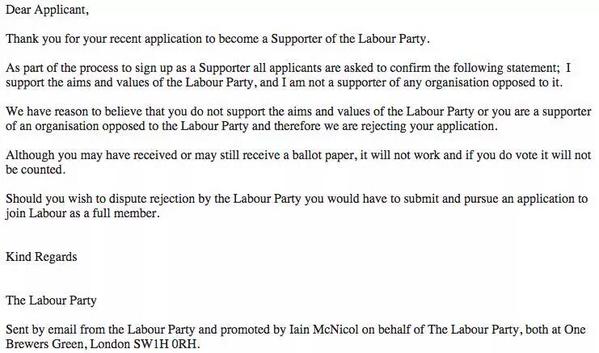
This is what is happening at the moment. Social media is awash with stories of left-wingers having their applications for supporter status, or even membership, refused. People who campaigned for Labour in May have been turned down, as have some who have gone to the super-rogatory extreme of attending CLP meetings. Attempting to defend the purge, right-wingers make vague noises about people "campaigning against Labour", a charge that often seems to amount to little more than having tweeted something unfavourable about the party leadership. In some cases the grounds are even weaker:
Heard a woman was barred from voting in the leadership because the Labour employee doing the purging knew her to be left wing. #LabourPurge
— Ellie Mae O'Hagan (@MissEllieMae) August 20, 2015
The right is actively soliciting the details of people which it thinks it can get away with barring from voting:
The catch-all email sent out to the purged states that the Party has "reason to believe" they do not share Labour values. In many cases, people have interpreted this as meaning that they have supported non-Labour candidates, however much in the distant past that may have been. One notes that a similar rationale isn't applied to floor-crossing Tory MPs, whom Labour has always greeted with open arms. Nor were the membership applications of scores of ex-SDPers, some of them central to the Blair project, at least one of them (Polly Toynbee) a very active anti-Corbynite at the present moment, who have joined since the Blair years.
The Blairites are in full counter-attack. The left must stand our ground; so much is at stake. If you have been purged, don't just drift off in a sulk: that is the intended effect of this. Challenge it, make a noise about it, and register your details here.
The best form of defence, of course is attack. And if nothing else, the events of the past few days should convince us that winning the leadership is not enough. To undo the Blair project, we have to oust it from CLPs, the party machine, and the PLP. The CLP left, dormant for far too long, has to wake up, contest positions and vote in trigger ballots. It's not always clear to me that the need for this kind of action - which will inevitably be pretty tough and uncomfortable - at times has sunk in. There is a lot of talk at the moment about consensus building. This is no doubt well-intentioned, but seems to be grounded in an out-of-date analysis of where the Labour left is at: the Corbyn surge renders the project of winning the hearts and minds of a shrinking Labour centre irrelevant, for the time being at least.The sad truth is that consensus is not always possible. Two utterly incompatible visions for the labour movement are coming head to head. And one of them must lose.
Friday, 17 July 2015
Right to strike

Just a very quick post to plug the Right to Strike campaign - there is no more important battle in Britain at the moment than the one against the Tories' proposed anti-union laws that will impose harsh turnout limits on strike ballots, effectively counting every abstention as a 'No' vote, legalise the use of agency scabs, and undermine political funds. These rights are the result of a history of struggle, and are needed today more than ever, as working life is being subjected to casualisation and insecurity.
The initial target are public sector unions. In particular, I'm convinced that the Tories have RMT members on the London Underground squarely in their sights. The capacity of a union to bring the capital to a halt is an asset to our movement and an embarrassment to Cameron, who views them as Thatcher viewed the NUM.
Pass motions in support of the campaign at your union branch and local Labour Party, and keep an eye on the website. There are mobilising meetings coming up.
Video from Stronger Unions
Subscribe to:
Posts (Atom)