Showing posts with label Blairism. Show all posts

Monday, 27 June 2016

There are weeks when decades happen

There's nothing like a popular vote to remind you where power lies in society; spoiler - not with popular votes. Thus, the hands of any British government wanting to operate within broadly mainstream economic constraints were today tied, not by the electorate, but by the ratings agency Standard and Poor, who cut the UK's credit rating. Expect others to follow. More generally, those most curious of creatures known as 'the markets' have not responded well to Thursday's Leave vote.


It would have been possible for a determined Leave campaign with a co-ordinated economic plan, prepared to stray beyond both mainstream constraints and the interests of capital, to manage a Leave vote in a way that didn't promise widespread poverty and public spending cuts whilst keeping the, uncertainty averse, forces of global credit capital and those irksome markets sufficiently content to spare it the coup de grace. However, that is not the Leave campaign we had: that was a monstrous concotion of xenophobes, British nationalists, economic reactionaries, and oddballs: an assembly of grotesque misfits wrapped in the Union Jack, who could only appeal to anyone on the basis of a widespread discontent, disaffection and desperation in search of an outlet. They had no plan, other than to 'Take Back Our Country' and 'Make Britain Great Again', all the while defending the sectional interests of a narrow part of British capital with no sense of a broader picture.

There is much still to say about the campaign, the EU, and the British economy. There is even more to say about what the referendum result shows about class. And there is still more to say yet about the petulant arrogance of much liberal reaction to the result. A strand of opinion in broadsheets, academia, and the Waitrose-shopping end of social media thinks that what last Thursday showed was that the swinish multitude should not be trusted with big decisions.

I will write about those things at some point. More urgent than any of them is the foul upsurge in open racism that has followed on the referendum campaign and result. Make no mistake, it wasn't that these things caused racism. Britain is, whatever the panglossians who inhabit Guardian columns might imagine, a racist society through and through. However, racism often lies buried - waiting nervous and Gollum-like in the shadows, consumed with self-hatred and unwilling to show its face. That it does is one of the greatest political achievements of recent decades. Yet, it's still there: hidden behind the remark that 'the area has changed', disguised as patriotism (if the two can ever be disentangled), implicit in a choice of friends. Once mainstream political discourse gets racialised, as it was by the immigration-focus of both main referendum campaigns, racists gain confidence. Things usually unsaid are spoken aloud. Combine this with the jingoistic upsurge that followed the result, the general flag-waving feel of Jubilee year, and most noxiously the ever-present threat of the far-right, and you have a toxic mix.

Jo Cox was its victim. There have been others. Since Thursday, racial abuse soared. Eastern Europeans were a particular focus: with cards reading 'go home Polish vermin' distributed outside a Cambridgeshire primary school. In West London, a Polish cultural centre was attacked. In East London two Polish men were beaten unconscious. The list of incidents goes on and horribly on:


But at least there's a political party in Britain, committed to equality and anti-racism, that will make the case strongly against racism, and build a cohesive movement in solidarity with its victims, right? Enter the Labour Party, glorious and ready to do battle against injustice and bigotry. Well, ordinary party members have been doing this. The PLP, however. Well, as the far-right roars and the economy falters, their priority is obviously to try to topple a popular leader who has increased Labour's share of the vote and presided over modest, but real, by-election successes.

The line is, of course, that Jeremy's weak leadership was responsible for the Leave vote. This is nonsense on several levels. Never mind the fact that Corbyn is not a weak leader - although this would not appear obvious to those whose idea of political leadership looks as though it has been cobbled together from a few evenings watching The Thick Of It - but that the bulk of the PLP don't want to be led by him, or by anyone with political ideas remotely similar to his. Never mind the fact that Corbyn was not in a position to persuade key Labour constituencies to vote Remain: one of Blairism's besetting sins is the reduction of politics to campaigns and soundbites, whereas all of those Leave votes in the north-east of England were about decades of feeling forgotten, being stripped of hope, crushed economically, and mocked culturally; not matters that can be set right with a broad grin. Never mind the fact that the only thing that would have been achieved by Corbyn going in all guns blazing on behalf of Remain would have been a Scotland-style meltdown in Labour support in parts of the north of England. None of this matters.

It is irrelevant because the coup is not actually about the referendum campaign or Corbyn's leadership style. It is about politics. A sizeable chuck of the PLP, Blairite clones imposed during the years when Labour had the imagination of Jeffrey Archer and the conscience of Dr Crippen, do not want a left-wing leader. You understand nothing about New Labour until you understand that it is about making the Labour Party permanently safe for capitalism. Most of its warriors, not being the most cerebral of souls, would be a bit hazy about what the word 'capitalism' means, preferring instead to wax lyrical about 'a dynamic, modern, economy'. For sure, New Labour is about winning elections, but not at any cost. Their lord and master Tony Blair let the cat out of the bag in this respect when he said that he would not take the 'route to victory' if it were a left-wing one.

In actual fact, the quisling tendancy in the PLP may not have to choose between power and principles. It is not inconceivable by any means that we will see some kind of National Government on a somehow-managing-to-Remain basis - composed of Tories, Lib Dems, and an SDPesque rump of Blairites - after an autumn election. Whether the split will come before or after this election will depend on the right's tactics, and whether they have the front to let unions and party activists pay in time and money for their election. (Incidentally: this scenario should be anticipated and pre-empted. Bold thinking about Scotland, up to and including the possibility of an electoral pact with the SNP in exchange for the promise of a second independence referendum, should be considered).

We cannot stop the right being right-wing. Nor can we make them loyal to the leadership: the strategy of a 'kinder, newer, politics' has been tried, in good faith, and has failed. The co-ordinated spotaneous resignations of shadow ministers throughout today put that beyond doubt. Now is the time to fight for the Labour Party. This, to be sure, should not be at the expense of defending communities against racism, nor at that of arguing for an alternative strategy on the economy. However, the remaining strangehold of the 1990s on Labour in parliament is a barrier to doing both these things. Words like 'accountability' and 'deselection' have now to be uttered openly. At constituency level the left has to plan so that the Labour Party in parliament in future looks more like the Labour Party at large.

The immediate priority is to support Jeremy. He is under attack, facing a vote of no confidence as I write. See Momentum here for a petition, and keep an eye out for more ways of offering support. These are desperate times within the Labour Party. Yet there is some hope. Here is Parliament Square this evening:


Thursday, 20 August 2015

Purge away


"Politics is all about struggle", so began the first lecture on political ideas I attended as a new undergraduate. The lecturer, a brilliant amalgam of Marxist and anarchist, took a deep breath before delivering his punchline: "This is what Tony Blair doesn't realise; hence the inane grin on his face".

It was a good line. As a Labour Party member in the mid-90s I knew however that, like many good lines, it was untrue. The Blairite project, that partially successful push to capture the Labour Party for big business, was about nothing if it was not about struggle. The generation of Labour staffers, hacks, and aspiring student politicians (one Jim Murphy was particularly prominent at the time) needed no lessons from the far left on this front. Elections were rigged, candidates parachuted in, leftists denounced (the word 'Trotskyist' during this period lost any meaning other than 'someone more left-wing than me'), and the Party gradually staffed with people on board with the gospel according to Blair. In the rare eventuality that these measures failed to secure the desired end, there was always the last resort of brute diktat: witness Liz Davies deselection as candidate for Leeds North East.

I tell you this not by way of reminiscence but in order to, as kindly as possible, point out that Blairism was never going to roll over and die. It was born out of a struggle for the soul of the labour movement, and will kick and bite until its last breath. Corbyn has been leading the polls for weeks, seemingly unstoppable, his meetings packed, and his campaign gaining momentum. The spads and hacks, a good number of whom make up the PLP, were hardly about to shrug their shoulders and tut 'well that's that, then' before giving up politics in favour of gardening. Over two decades Blairism gained near total control of the party machine, both at the level of full-time staff and of officers in many CLPs. It was inevitable that it would use that positional advantage in an attempt to stop Corbyn.

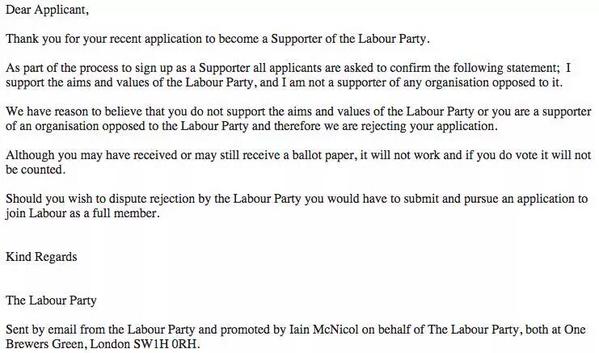
This is what is happening at the moment. Social media is awash with stories of left-wingers having their applications for supporter status, or even membership, refused. People who campaigned for Labour in May have been turned down, as have some who have gone to the super-rogatory extreme of attending CLP meetings. Attempting to defend the purge, right-wingers make vague noises about people "campaigning against Labour", a charge that often seems to amount to little more than having tweeted something unfavourable about the party leadership. In some cases the grounds are even weaker:
The right is actively soliciting the details of people which it thinks it can get away with barring from voting:


The catch-all email sent out to the purged states that the Party has "reason to believe" they do not share Labour values. In many cases, people have interpreted this as meaning that they have supported non-Labour candidates, however much in the distant past that may have been. One notes that a similar rationale isn't applied to floor-crossing Tory MPs, whom Labour has always greeted with open arms. Nor were the membership applications of scores of ex-SDPers, some of them central to the Blair project, at least one of them (Polly Toynbee) a very active anti-Corbynite at the present moment, who have joined since the Blair years.

The Blairites are in full counter-attack. The left must stand our ground; so much is at stake. If you have been purged, don't just drift off in a sulk: that is the intended effect of this. Challenge it, make a noise about it, and register your details here.

The best form of defence, of course is attack. And if nothing else, the events of the past few days should convince us that winning the leadership is not enough. To undo the Blair project, we have to oust it from CLPs, the party machine, and the PLP. The CLP left, dormant for far too long, has to wake up, contest positions and vote in trigger ballots. It's not always clear to me that the need for this kind of action - which will inevitably be pretty tough and uncomfortable - at times has sunk in. There is a lot of talk at the moment about consensus building. This is no doubt well-intentioned, but seems to be grounded in an out-of-date analysis of where the Labour left is at: the Corbyn surge renders the project of winning the hearts and minds of a shrinking Labour centre irrelevant, for the time being at least.The sad truth is that consensus is not always possible. Two utterly incompatible visions for the labour movement are coming head to head. And one of them must lose.


Monday, 11 May 2015

Guest Post by Jen Izaakson and Ross Speer : Blairism killed Labour, it cannot revive it


Blairism is the sickness infecting Labour. The strategy of triangulation that fueled its electoral success was based on shifting the Party to appeal to wealthier Home Counties residents through an ideology of progressive individualism, whilst assuming its working class base would have nowhere else to go. Permanent majority.

But things did not turn out the way they were supposed to. Since 2001, Labour’s core voters have increasingly just stayed at home. As much was evident again in 2015: voting turnout in northern working class constituencies was generally below those of Tory supporting areas. But, since 2010, those voters have once again come to the ballot box to vote UKIP – who are unafraid to talk the language of class – and the Green Party – who defy the Blairites assessment of the situation to pick up votes in the southern counties on a left-wing platform. Turnout in the former Labour heartlands of Scotland bucked the trend, as voters were finally coaxed back into action by the SNP’s leftwards anti-austerity pitch. Blairism waged war on the Labour Party’s own base in order to attract Tory voters. Now it is reaping what it sowed.

If the left is to rise again it must correctly identify the ills of society. Blair failed to do just that. He gave in to the basic themes of Thatcherism: The state is problem, the unrestrained market the solution. Industry is gone, the service sector will deliver the goods. It did not turn out like that. The transfer of wealth from poor to rich continued unabated, driven by a buoyant property market and stagnant real wages. Austerity was merely the culmination of a long trend; itself possibly amongst the biggest single upward transfers of wealth in history.

Blair’s defenders point to the minimum wage and Sure Start as unambiguous successes. But would it not have been possible to do those things without, say, pulverizing Iraq, PFI schemes, attacking civil liberties, allowing the expansion of inequality and tax dodging, and the fattening of an unrestrained financial sector? And let’s not forget the failure to build new council housing, permitting massive rent rises, letting the Murdoch media run wild, maintaining the anti-union laws, introducing tuition fees, giving up on nuclear disarmament and keeping major infrastructure in private hands. Were those really the price of victory, or were they gratuitous concessions to the right? It is certainly not obvious that the historic capitulation of Britain's premier left party to the dictates of big business was worth £6.50 an hour. The Blairites like to talk about
aspiration, and they’re right to do so: We aspire to do better than what they offer.

What the left needs is a vision, a narrative that starts out from policies and positions that are already popular. Fortunately, we have plenty to work with here. From
nationalisation of the railways and energy companies, to higher taxes on the rich, to pegging the minimum wage to the living wage, there are numerous ways the public is to the left of anything being proposed by the Labour Party. And that is before the case has even seriously been put, for no major force in England currently makes these arguments. Miliband tried to sprinkle a few vaguely left policies on top of Tory austerity, all infused with a dash of UKIP-style immigration policy. The result pleased no-one. Labour did not lose because the Tories rallied many more people to their crusade than in 2010 – they increased their vote share by a measly 0.5% compared to Labour’s 1.5% - but because the Miliband Compromise between the Party’s left and right failed to sufficiently inspire its natural voters. All the elements exist for a Blairite-free program of the left; we only now lack a cohesive story about what Britain is and could be in the 21 century to bring them all together.

A battle for the soul of Labour is underway. If the catastrophe of Jim Murphy’s election to the Scottish leadership has sunk Labour north of the border, there remains a chance in England. The Blairities have, as usual, been first to the draw. They are eagerly spinning a tale of how Miliband’s illusory left-turn lost them the election. If they succeed, they will turn the Labour Party into the Tory surrogate that they so sorely desire. Their final crime may well be the rise of UKIP, who will eagerly seize upon the working class voters that they are abandoning. Mandelson has already begun a renewed assault on the trade unions. The silver lining may be, if McCluskey & co. finally decide the game is up, that a new social democratic could be set up in Britain. If that comes to pass, then the Blairites can keep their hollowed out brand.


Friday, 3 January 2014

The Analysis of Blairism (i) - A Class Project

Long Post warning

A couple of days ago I had things to say about the position of the Left in the Labour Party, and this got me thinking about Blairism. It seems to me that we can't understand where we're at properly unless we begin to understand what happened to Labour under the Blair leadership, and how Blair's project continues to work itself out in the present day Labour Party, especially as we approach March's special Conference and possible modification of the Party's relationship to the trade unions.

I want to understand these things better. So I'm going to think out loud, or at least begin to think out loud, in a series of three posts on Blairism, of which this is the first. I've been helped a lot by Graham Bash and Andrew Fisher's excellent little book on the history of the Labour Party, as well as by (Ralph) Miliband and Cliff/ Gluckstein (oh for the blissful days when SWPers wrote useful things).


One response, which is pretty common on the Labour Left, to the phenomenon of Blairism is to deny that there is any such thing. To be sure, the Blair (and subsequently Brown) governments betrayed the hopes invested in them by many Labour voters and did lots of bad things. But this is hardly unparallelled; to a greater or lesser extent the same can be said of every Labour government. Nor is it even clear that Blair's governments were uniquely bad: privatising air traffic control may be deplorable, but it's not obviously worse than supporting the attacks on Hiroshima and Nagasaki. And before there was Iraq, there was Vietnam.

If Blairism is to be considered interesting, and of enduring significance for labour movement politics, there has to be more to it than a succession of right-wing policy moves, however individually distasteful. I think that there is something more; I think that Blairism can be understood as a move to decisively reorientate Labour's class representative role. In outline, I believe that Blairism ought to be regarded as an attempt (by no means exhausted) to reconstitute Labour as a party of 'progressive' European-orientated capital.

Labour and Reform


It's something of an old Trot commonplace that Labour is a 'bourgeois workers party'. Being an old Trot commonplace is not incompatible with being true, and this is a case in point. British Labourism is a curious affair. On the one hand, we have a party with a solid working class base, born (in Nye Bevan's words) "from the bowels of the TUC", and over which the trade unions can exercise a degree of influence. Yet, on the other hand, we have a party wedded to the norms of the liberal state, to a divide between the economic and the political (to such an extent that, for the greater part of the Party's history - until the Bennite reforms of the early 80s - the PLP was completely independent of the wider movement), and to the class compromise that all of this entailed. The outcome of these tensions, present from the beginning, is that Labour has functioned to represent the working class politically within capitalism. Labour's existence both encourages class politics and tends to place limits on the imagined scope of those politics. The Party has both delivered historic reforms that have transformed the lives of working class people and, in the very act of doing so, bound them more closely to a system that survives by exploiting them.

All of this is workable for as long as Labour governments can deliver reforms benefiting the working class, thereby justifying their continued existence to their core electorate and the union bureaucracies. A standard narrative, widely believed on Left and Right, holds that Labour governments can no longer do this. In Cliff and Gluckstein's neat phrase Labour now has to offer "reformism without the possibility of reforms". The point of inflexion here is usually seen as the crisis of the mid 1970s, associated with the OPEC price shocks and culminating in Britain with the IMF bail-out of the Callaghan government and the resulting implementation of austerity measures. Before things got to that point, in 1976, Callaghan himself sounded the death-knell for the 'Keynesian'* macroeconomics that had been the power-house of post-war reformsim
we used to think you could just spend your way out of recession... I tell you in all candour that option no longer exists and in so far as it ever did exist, it only worked... by injecting a bigger dose of inflation into the economy, followed by a higher level of unemployment.
Shifting Phillips curves were the order of the day in the world of economic ideas. And in the hard cold world of institutional reality, new ties appeared for the hands of reformist governments. The Bretton Woods framework, which had provided a secure international context for the British post-war settlement, ended in 1971 when the US terminated the convertibility of the dollar into gold. The UK's 1973 membership of the Common Market, confirmed by the 'yes' victory in the 1975 referendum, tied UK policy-makers to a "free market economics" and posed long term problems for public ownership (particularly in terms of  reversing privatisations). The growth of transnational corporations seemed to pose problems for planning - left economist Stuart Holland's 1975 The Socialist Challenge expressed well the nature of this concern in the labour movement; he spoke of a 'mesoeonomic' sector of corporations interposed between government policymaking and the desired effects in working peoples' lives.  In the next decade, the Thatcher governments' deregulation of finance and foreign exchange foreclosed further on the options for a future Labour government.

An undoubted result of all this is that Labour governments can no longer run reformism after the exact model of the post-war consensus. I am not myself convinced that reformism as such is not longer possible. The relative continued effectiveness, and undoubted effect, of macroeconomic policy, particularly evident since the 2008 crisis, surely places a question mark over some of the more extreme claims about governmental impotence. But that isn't what matters here: what matters is a widespread collapse of belief in reformism since the mid-1970s. This was summed up quite nicely by Tony Benn in his 1981  Arguments for Democracy: the post-war consensus was spent, the options facing the British electorate were "monetarism, corporatism, and democratic socialism".

Shifting the focus from the national polity to the labour movement, it looked like the reformist project's day had passed. The contradictions of Labourism needed to resolve themselves. Labour could no longer represent the working class within capitalism by offering reforms. It had to either become a socialist party, or else - in the language of two decades later - a party of business.

Resolving the Contradictions? Benn, the SDP, and Kinnock


An increasingly militant constituency Left in the early 1980s favoured the socialist route. For the Bennites this meant not only socialist policies - Labour Conferences had been voting for these for a good few years - but structural reform of the Labour Party to favour the implementation of these policies when Labour was in government. Thus democratisation of the manifesto, mandatory reselection of MPs and similar measures became priorities. Trade union influence on Labour politics increased, for example with the introduction of an electoral college for leadership elections (a measure which also sounded the death toll for a key feature of traditional Labourism, the independence of the PLP). In other ways, boundaries prescribed by Labourism were transgressed, for instance by policy proposals advocating roles for trade unions in industrial management. None the less, the 1980s Left had no intention of weakening the link between Labour and the unions; to that extent the Party's heritage as a trade union party was unthreatened.

One might have expected a threat to come from the Party's Right. If they offered no policies which union leaderships could sell their members - and recall that this was a period of intense pessimism about the possibility of reforms - wasn't there a possibility that unions could become a thorn in the Party's side? As it happened, there was no real antagonism between unions and the rightward drifting parliamentary Party during the Kinnock years. Partly this was because the most right-wing elements of Labour had exited to the SDP, partly because the overwhelming priority was the defeat of Thatcher and Labour (however bad) provided the only electoral hope here, partly because the union movement was - as unemployment increased, the sectoral balance of the UK economy shifted, and especially after the defeat of the 1984-5 miners' strike - on the back foot, and under right-wing leadership, and partly because unions were an important source of finance for the Labour Party.

Whilst the union link remained intact, the Kinnock years did witness a clearing of the ground for a later rightward shift away from traditional Labourism. Left-wing policies adopted during the 70s and 80s were quietly abandoned, and the possibility of a leftward break was weakened by the defeat of Bennism, the anti-Militant purges, and the failure of the leadership to support the GLC and other local government struggles. Of more enduring importance, as the leadership took on board fashionable sociological claims about the changing nature of its working class support, its basis for appeal to that support changed, becoming less collective, and more directed at atomised self-interest, adopting rather than challenging key ideological tropes of the Thatcher era. As Benn's diaries describe a seminar presentation as reporting a survey of Labour voters, "it's nice to have a social conscience, but your family comes first".

In all of this the Kinnock years served as a kind of John the Baptist, a forerunner for the Blairite messiah.

A saviour from on high. Blair and Blairism


The tragically cut-short leadership of John Smith provided a temporary respite for Labourism, whilst the Tories sunk under internal divisions and the ERM fiasco. Then things changed.


The fundamentals of Labourism remained unchallenged at the start of the Blair era. The union link was unbroken and, however weakened Party demoracy might have felt, the labour movement was still capable of translating demands into policy - hence genuinely welcome policies of the Blair governments, such as the minimum wage and the restoration of trade union rights at GCHQ - as well as of applying brakes on excessive rightward drift. Yet there was a malaise in the air. Labour had lost four successive general elections, and for all its compromises was beginning to look like a party of perpetual opposition.

At the same time, by the early to mid 1990s, the role of the Tories as the unrivalled political representatives of British capital was looking shaky. Divided on Europe, but increasingly shifting in a Eurosceptic direction, the appeal of the Conservatives to capital focused on EU markets was limited. Moreover, a basic contradiction in the Tories' relationship to the capitalist class reared its head. Capitalism brings its wake relentless social change - "all that is solid melts into air". It has embarrassingly slight intrinsic respect for hierarchy, it cares little for morality and order beyond their capacity to secure profit. Family structures, national boundaries, ethnic identities - all are up for negotiation as eagle-eyed entrepreneurs seek out the next market. Since the 1960s, even as the industrial world had been opened up more completely to the ravages of capital, attitudes had grown more liberal on a range of issues: homosexuality, the family, race and racism, sex and sexism. And a good proportion of the bourgeoisie took this shift in attitudes on board, to a greater or lesser extent. Meanwhile they were represented politically in the UK by the historic party of order, the party of Section 28 and 'Hang Nelson Mandela' t-shirts, the Party which one of their own ministers termed 'the nasty party'.

Wasn't their room for a more modern, more progressive, more pro-European party of capital? Enter Tony Blair. Speaking to the FT in early 1997, Blair said (quoted in Bash/ Fisher),
I want a situation more like the Democrats and Republicans in the US. People don't even question for a single moment that the Democrats are a pro-business party. They should not be asking that question about New Labour.
New Labour courted business, and its flirtations were well received, with high profile donations from corporations and wealthy individuals. The gory details of the romance are well documented in Dave Osler's book. At the time, the long-term prospect of a New Labour lacking financial dependence on the unions seemed real. New Labour's policies remained a matter of negotiation between the representation of labour and of capital, I've already mentioned a couple of significant pre-existing labour movement policies that were implemented. Yet there was a definite shift in political economy towards acceptance of neo-liberalism. The rewriting of Clause IV had a symbolic importance here. Meanwhile the relationship between the PLP and the widered movement was negotiated. Party democracy withered (in rather the same way that plants wither after being sprayed with weedkiller), National Policy Forums were introduced, Conference decisions on policy routinely ignored, and candidate selections fixed. Blairism exerted itself as a force through organisations like Progress. Meanwhile, front bench spokespeople appealed over the heads of the movement, to individual electors, understood as consumers. This was the age of political advertising and 'spin'.

In all these ways there was a shift away from Labour even attempting to represent the working class, in however a mediated fashion, and towards it being simply another party of capital, offering itself to the electorate periodically as perhaps the least-worst alternative. Voices around Progress were quite clear that they would like to make the break with Labourism permanent and institutional, eyeing up the union link. Others, prior to the May 1997 landslide which rendered the question irrelevant, mooted working with, or forming coalitions with, the Liberal Democrats, another move which would have undermined the relationship between a Labour government and the labour movement.

Neither of these attacks on Labourism came to pass, and Blair is now redirecting his messianic energies beyond the bounds of the Labour Party, setting himself the modest task of bringing peace between the worlds' religions.  Yet the Blairite assault on Labourism is still warm. Coalition with the Lib Dems remains a live possibility after the next election. And, of course, the union link is a live topic, discussion of which is due to come to a head this March.

And that will be the subject of my next post in this series.


 *It's not really fair to Keynes to attribute to him the view that you could "just spend your way out of recession" but that's another post for a special type of geek.