Showing posts with label leadership. Show all posts

Monday, 19 September 2016

The Nye and Owen Show


The greatest of thinkers stand on the shoulders of giants. Owen Smith, it is fair to say, is not a great political thinker. Still, he tells us that he is standing on the shoulder of one the labour movement's giants. Debating with Jeremy Corbyn on television he said:

I want to be a force for good in the world. Therefore, you need to achieve power. Nye Bevan, my great hero, said it’s all about achieving and exercising power. I’ve devoted my life to that.
(Stolen from Left Foot Forward)

I'm a little confused about this, I must confess. Is the Nye Bevan being spoken about here the same Nye Bevan who said this?

The Right Wing of the Labour Party would rather see it fall into perpetual decline rather than abide by its democratic decisions.
What about this, given that people have been expelled from the Labour Party recently for saying far less barbed things?

That is why no amount of cajolery, and no attempts at ethical or social seduction, can eradicate from my heart a deep burning hatred for the Tory Party that inflicted those bitter experiences on me. So far as I am concerned they are lower than vermin.
 
Then there's this, a Bevan quote favoured by today's self-professed moderates, but in actual fact a neat statement of a basic of historical materialism:

Freedom is the by-product of economic surplus.
Let's face it, Nye Bevan would have been expelled from today's Labour Party. Because the Compliance Unit would know all too well who would be getting his vote.

Sunday, 31 July 2016

Alas piffle Jones

The mere fact that something is a truism does not imply that it is true. One example is "what doesn't kill you makes you stronger", a thesis it would be interesting to test out on Polio victims. Another is "the pen is mightier than the sword". I'm not actually aware of any historical instance of a writer taking on a fencing master armed only with a Parker fountain pen, but if this did happen, I suspect it did not end well.

The point is, of course, supposed to be about the power of ideas, and to that extent there is a certain truth in it, which is a comfort to those of us who are far more comfortable inserting semi-colons into sentences than we would be thrusting rapiers into a foe. Amongst this legion of geeks I count myself. Still the kind of ideas with which I am concerned here, political ideas, are powerless in the absence of a political movement, and are only formed reliably in close critical relationship with such a movement. This is, understandably in the wake of the SWP rape crisis, the kind of talk which evokes nervousness on much of the left; yet it is often the most vital maxims that require the most careful handling. Whatever is meant by 'a movement', it has to be more than the whims of some central committee. But that is a matter for another day. When ideas come apart from a movement which they can inspire, and which can test them in the crucible of daily life, then they become lifeless things, phantoms and illusions.


Which brings me to Owen Jones. I am, I should say, angry about his intervention in the Labour leadership contest. The Labour left which gave rise to Jeremy Corbyn, and which is currently being tried in his person, also provided Owen with a hand up to his career as a commentator. I remember well him cutting his teeth in the pages of Labour Briefing and his early political days as a co-chair of the LRC's youth wing. He was born of the movement to which he has delivered a timed slap in the face. It is sometimes said that the Left speaks too easily of betrayal, and there may be something to this. Yet a sensitivity to treachery is the flip-side of valuing comradeship. If you are prepared to show solidarity with me, I should be similarly prepared to take you into account in making my own decisions. This might be uncomfortable talk for those for whom individual freedom, or career, or whatever else is the highest conceivable good. Others of us think that the freedom to shout lonely in the desert is no freedom worth having.

In what does the betrayal consist here? A political writer who views their writing as an intervention, as opposed to, say, a means to a better CV has to consider not only what they want to say but whether this is the right time to say it. There is much that could be said and asked about Corbyn and the movement around him; I have myself been far from uncritical. The time for articulating that is not, however, when the man is seeking re-election as leader of the Labour Party in the wake of a concerted attempt to wrestle the Party back into the hands of the Blairite cabal. There is a question we should ask ourselves before we ask questions of others. That is the question implicit in every picket line, "which side are you on?"; and the answer we give to that provides the context for our subsequent questioning.

Owen has chosen to lay bare his soul on the internet; that is his decision. I have nothing to say about it. Of more interest are the nine questions he asks at the end of his piece - without, one notes, offering much in the way of answers. Marx said that each age asks only the questions which it can answer. He might have added that the way those questions are understood, and for that matter framed, constrains the answers that are considered admissible. Nowhere is Jones' descent into a bland safe parliamentariansim more apparent than here, the sense he gives of what an acceptable answer to each of his questions would look like. I do not consider myself similarly bound by the norms of Westminster nicety, and for what it's worth I think that the primary reason the inhabitants of Westminster's famed bubble (amongst whom Owen must now be numbered) are disturbed by the member for Islington North is that he has refused to play the game of Westminster politics as normal. For all that, Corbyn is still a reformist, and some kind of answer to Owen's questions is probably needed, given that they have now been asked.

Here, off the top of my head, is a first attempt. 

1. How can the disastrous polling be turned around? Well, a few of us have been expressing concern about the polls for a good while. There's a lot that I would want to say about the need for forming a movement that works at community level to form 'public opinion', rather than receive it as a passive given. It is the model of politics as an exercise in customer relations, rather than social transformation that needs to be challenged above all else by any Left movement that takes contesting elections seriously. The point is not that we should not want to win elections, but that we need a new approach to how we win elections.

All of this said, Labour's polling really warrants the term 'disastrous' during the period since the EU referendum and the beginning of the relentless attacks on Corbyn from within the PLP. Outlandish though this idea might seem, perhaps Labour might do somewhat better in the polls if those attacks were to stop.

2. Where is the clear vision? I don't really understand the question. There is a reading of "clear vision" on which the phrase is as oxymoronic as "thoughtful Sun journalist". Vision is the stuff of motivating principles, big ideas, and utopian imagining. Vision is not meant to be clear in the sense that Owen seems to demand. The parable of the Good Samaritan presents a vision of how human beings might live, but it wouldn't necessarily be much use on the doorstep. It would certainly be a brave minister who gave it to a civil servant as indicative of the government's intentions. I think anyone who believes that Jeremy lacks vision in this sense hasn't been listening to him. Much of the British population has a good excuse for this, since much of what Jeremy has said hasn't been reported. If only there was, for example, a left-wing writer with a regular column in a national paper who could help on this front.

Perhaps, though Owen is concerned with policy rather than vision. Some of these have been forthcoming: think about John McDonnell's announcements on matters macroeconomic, providing a clear alternative to the Conservative programme. But there have been relatively few detailed policies, this is true. Is this a bad thing? It depends whether you are happy with what one might call the Thick of It model of policymaking: policies arising ex nihilo from the heads of special advisors and the cars of front bench politicians en route to press conferences. Once upon a time the Left argued that policy should emerge from the labour movement, through its democratic structures. If this is right then it is a good thing that there hasn't currently been much policymaking in Owen's required sense. Here we see the double bind in which Corbyn is being placed: if he doesn't do politics as usual, he is criticised; if he does do politics as usual, what is the point in Corbyn?

3. How are the policies significantly different from the last general election? See answer to previous question. Jones does accidentally touch on the interesting area of economics. Here McDonnell is quite right not concede to pseudo-Keynesian nonsense about the deficit. Yet in the background lurks a more troubling issue: capitalism can no longer afford social democracy. It's not simply a question of "the money being there", as the familiar leftist refrain has it, but rather of whether capital views the money being used for [insert favoured social spending here] is consistent with the reproduction of capital. This was the case during the long (and exceptional) post-war boom; this is in general no longer so. That doesn't mean nothing can be done - here again, I have not been uncritical. McDonnell is not, that criticism aside, not without good ideas - to with redistribution, investment, and productivity. Far more importantly, Corbyn's Labour is committed to setting working people free to fight for themselves, to do what the state can increasingly no longer do. The repeal of the Thatcher era trade union legislation is far, far, more important than anything a Shadow Chancellor can do.

4. What is the media strategy? Once again, the assumption of politics as usual pervades the question. "Most people", that most useful of demographic categories for a columnist with an axe to grind, don't get their news from social media. They get it from the mainstream print and broadcast media. This is probably right. It does not follow that it is written into the grain of the universe that this is so. What if people had more opportunity to talk about politics through the presence in their communities and workplaces of a real mass movement? 

At this point, I feel slightly as though I'm lapsing into John Lennon territory: you may say that I'm a dreamer. So let's allow that what is said in the mainstream media matters. As indeed it does; hence all those books by 80s Marxist sociologists on the press. It is a difficult question what a socialist electoral movement might do to get the best media coverage. Even putting it this way, though, assumes that the traffic between media and politics is one way. The media follow as well as lead; the Scottish Sun at crucial points cannot get away with carrying the same line as its southern cousin - witness the vastly differing attitudes towards the SNP and independence in recent years. Newspapers need to sell in order to survive, and political consciousness determines what they can say and still sell. Allowing even that, there's still some kind of question: how might we get nice things said about Jeremy in the papers? Again I can only express my wish that there was a reasonably well-known left-wing journalist about who could help in this respect.

5. What's the strategy for winning over the over-44s? Well, as the man himself says, pensioner poverty and social care are important issues. And I simply do not believe that the interview Owen describes is the first he has heard from Corbyn on these questions.

6. What's the strategy to win over Scotland? Labour needs a really big rethink on Scotland and the national question. With this proviso, it would be pretty easy to make the ad hominum point that the people who presided over Scotland's reduction to a solitary Labour MP, namely the Labour right are not likely to be the best people to win it back for the party of Keir Hardie. However, it's not clear that Labour needs to win over Scotland. It held a majority in England in 2005.

7. What's the strategy to win over Conservative voters? Liberals can be useful in spite of themselves because, much like stopped clocks, they sometimes tell the truth accidentally. Thus Bill Clinton, "it's the economy stupid". There is good evidence that a good number of swing voters opted for the Tories because they didn't trust Labour on the economy. An economic strategy of the sort McDonnell has in fact crafted is a good start here. The task now is to communicate it, a task from which this leadership contest is an unhelpful distraction.

8. How would we deal with concerns about immigration? It's not because of immigrants that you can't get a hospital bed, a job, a council house... Talk about immigration, but talk about it precisely in terms of its function to deflect attention from the Tories' attacks. To say this is to treat the electorate as agents, who can be engaged politically, rather than as passive consumers to whose "concerns" we need to appeal. I'm terribly sorry, I should say in passing, that Jones' dire liberal baby, the Immigration Dividend, went nowhere, but them's the brakes.

9. How can Labour's mass membership be mobilised? This is the crucial question. I'm not really sure that it's a question for Jeremy Corbyn, though. It's a question for all of us. Over to you, Owen.


Saturday, 16 July 2016

This can't happen again. Support the CLGA slate for the NEC


The events of recent days have made it very clear why it matters that Corbyn supporters get elected to Labour's National Executive Committee. That body very nearly kept the leader off the ballot, and when it voted to include him it did so by means of a secret ballot. It has banned local Labour parties from meeting for the duration of the contest, prevented new members from voting and has introduced a £25 charge, prohibitively high for many, to register as a supporter.

We need a better NEC. So please, if you have a vote, vote for the CLGA slate:

Ann Black
Christine Shawcroft 
Claudia Webbe
Darren Williams
Pete Willsman
Rhea Wolfson


Thursday, 14 July 2016

On behalf of the mob


Intimidation in politics is no laughing matter. There are parts of the world where airing your political views will get you thrown in jail, beaten up, or worse. Westminster, it is fair to say, is not normally one of those places.

This makes events in the past 36 hours of Labour politics perplexing. As the most right-wing government in living memory was appointed - Britain now has a Chancellor who holds the general public responsible for the 2008 financial crisis and a Foreign Secretary who wrote a poem about the  Turkish president having sex with a goat* - the theatre of conflict in Labour's civil war moved to the NEC.

The NEC voted to place Corbyn on the ballot without requiring that he seek nominations. This much is good news. What is less fantastic is that this vote was conducted by secret ballot. Corbyn and others voted against having a secret ballot. They were right to do this: NEC members ought to be accountable to those who elect them, and this requires their voting record be public. Accepting this is part of what prominent elected office in a democratic organisation involves: it is not everyone's cup of tea, it inevitably attracts lobbying and criticism. It can be hard. But this is democracy in action: NEC members (or MPs, for that matter) do not hold their position by right. They are put there by members and accountable to members. Lobbying, arguing, disagreeing with representatives is part of healthy democracy. To subscribe to the idea that the people (the demos - those of us NEC right-winger Johanna Baxter called, in solid Burkean conservative tradition, the 'mob') get their input only at election time is not to take seriously what it is for the demos to rule.

This does not mean that anything goes. It hardly need be said that the putting of a brick through Angela Eagle's window is disgraceful, and the sharing of Baxter's own personal mobile number on-line should be condemned. However, there are channels to deal with this kind of behaviour: legal recourses and internal Party procedure. These exceptional cases are being used as cover for a broadening of the understanding of 'intimidation' to block avenues of accountability and undermine the Corbyn campaign. So, the Guardian reports of Baxter:

“A prominent journalist was texting members of the NEC, saying they had to vote for Jeremy, a union general secretary was phoning round members of the NEC telling them they had to vote for Jeremy,” she said. “It is intimidation and he endorsed it.”
It cannot be stated loudly or often enough: the described behaviour is not intimidation. It is lobbying. And it is legitimate lobbying, as Labour's ruling body preprared to meet to make one of the most important decisions that has ever fallen to it. The fact that an NEC member is seemingly traumatised at the thought of a union leader, in particular, intervening in the politics of a party called, well, the Labour Party, is a timely reminder of why we should elected a better NEC this year.

Lobbying is not intimidation. Nor is anything which makes someone feel intimidated automatically intimidation. Peoples' responses can be unreasonable, and the ruling caste of a Labour bureaucracy that have got used to a professionalised model of politics which isolates them from the concerns and passions of the mass of humanity seem systematically conditioned to respond unreasonably to political pressure. Add to this a culture in which a therapeutic cult of universal victimhood has increasingly substituted itself for proper politics and in which disagreement itself is considered pathological - for which someone's much-vaunted right to their opinion is translated as their right not to have their opinion challenged - and you have a recipe for wrapping New Labour in cotton wool and, absurdly, claiming that the political force which rained bombs down on Iraq is a delicate snowflake, in need of special protection.

You have, moreover, an excuse for the further privatisation of politics. Engaging with the leadership election is to be something that happens in the seclusion of one's living room, on the internet, with a solitary vote. Participation in a mass political organisation turns out to be akin to watching porn. The merits of the candidates cannot be debated at Party meetings, because there will be no Party meetings until the election is over. Members are, in a masterstroke of collective passive aggression, being intimidated into not lobbying representatives or arguing on behalf of a candidate, lest they be thought abusive.

There are victims in this country. They will sleep on the streets tonight, or will be struggling to feed their children on the few coins they have for the rest of the week, or are crying alone in detention centres. They deserve representation, and that is why we, the Left, should not allow ourselves to be intimated.

*A gaffe which, given recent allegations about the former Prime Minister, if nothing else demonstrates an impressive amount of Tory chutzpah.

Saturday, 9 July 2016

A tale of two leadership contests

So the waiting is over; Angela Eagle has declared that she will stand for the Labour leadership. Unkind commentators might comment that if one of the problems with Corbyn is supposed to be his lack of charisma, viewing Angela Eagle as the solution is like pushing for Wayne Rooney to host Mastermind on the grounds that John Humphrys lacks intellectual gravitas.

This would be to misunderstand what is going on. Eagle is either a stalking horse or a sacrificial lamb - pick your favourite zoological metaphor. Her function is to instigate a contest. There is no thought amongst those who are presently cheerleading her that she will actually end up being the Labour leader. Instead, the plan is that some equally dull, but better known and supposedly member-friendly figure - Alan Johnson or Tom Watson - will be the benefactor from the coming bloodletting.

All of this is actually pretty boring. There is little to say about it that hasn't already been said. Eagle's statement makes it clear that she doesn't understand the Labour Party as extending beyond the bounds of the PLP. The same can be said about the widespread bluster about 'Party unity' from within the PLP. The present composition of the PLP is a boil that needs lancing for the Corbyn leadership to prosper; but this has always been the case.


More fascinating is the Tory leadership race. The party of Family and Order not only use women to bring about leadership contests, they are even open to having a woman as leader. Whatever one might say about the authoritarian Teresa May or the gibbering idiot Andrea Leadsom, they are undeniably both women.

This was enough to get Guardian columnists excited and have people chattering about 'feminism'. It is good, they argued, to have women in prominent positions. To be indifferent simply because one such position is that of being Tory leader is to be unflinchingly dogmatic, to prioritise other concerns over women's liberation. Similar sentiment lurks behind the insistence that Margaret Thatcher should be admired as a 'strong woman' or campaigns to get more women onto the boards of FTSE100 companies.

Admittedly, the feminist credentials of one of the candidates have taken a bit of a knock since it became clear that she believes having had sex with a man and having functional ovaries makes her better suited to being Prime Minister than her opponent. Yet there are more fundamental reasons to worry about the trend towards seeing examples of liberation amongst the ranks of the powerful. For one thing, it's not clear where the limits lie: would the election of Marine Le Pen as French President be a step forward in the war against sexism? But more fundamentally, whenever you hear that something is 'good for women', you should ask yourself which women?

It is perfectly true that the relative absence of women from the Tory benches and the boardrooms is a product of patriarchy. Tory MPs are disadvantaged because they are women: however that disadvantage expresses itself and is experienced in a way that reflects their typical class, racial, and religious backgrounds, and their prominent position in a right-wing political party. Compare their situation with that of a lone mother, going without food to feed her children on ever-reducing benefits. Would the ascendence of either May or Leadsom - both enthusiasts for austerity - be good news for her? What about a woman who gets paid less for doing the same work as her male colleagues? A black woman facing deportation? A Muslim woman victimised by anti-terror laws? Should a lesbian, bi, or transwoman rejoice at the election of either homophobe?


The power feminism that celebrates the Tory leadership contest allows basically reactionary political ideas to clothe themselves with a bit of post-60s diversity. In this respect it is analogous to campaigns for Muslim leaders or gay CEOs. It provides an easy option for those who want to feel the world is changing for the better without having to exert any energy to make it do so, as well as for those who fear that if the world actually did get better this might not be good news for their bad balance.

This should not be news to anyone vaguely on the left. If anything it is the kind of question which marks out the boundaries of the left. Most people, however, have no fixed politics of any kind. And there is a debate to be had with them about how best issues around gender, race, and sexuality are addressed. And here the argument has to be made and won that the only way to make progress in these areas in a way that actually makes life better for the bulk of the population - rather than holding out the largely illusory hope of 'making it' to a place amongst an elite - is as part of a movement that recognises the way these concerns intersect with class, and which organises and campaigns on the basis of all of them.

Which is why, of course, the battle for the institutions of the labour movement matters.

Wednesday, 1 June 2016

Corbyn and The Referendum Bind


Richard Seymour's book on the Corbyn phenomenon is well worth a read. Or at least, this is my judgement on the basis of having read two chapters earlier today. His take on the matter, which whilst being utterly supportive of the Labour leader is more pessimistic than is fashionable on the left , corresponds broadly to my own. 

That said, Richard brings out some genuine reasons for hope to which I think I've paid insufficient attention. The mere presence of Corbyn in the public sphere introduces left-wing ideas to a popular debate that has been dominated by neo-liberalism in recent decades. Meanwhile, his position as Labour leader and the related growth of groups like Momentum provides a context for a beleaguered British left to regroup and organise. We have more opportunities now, albeit ones we approach from a position of historic weakness, than we have had at any point in my adult life.

To state the obvious, this remaining the case depends to a large extent on Corbyn staying Labour leader. And there are people who have other ideas about that. From before his election as leader the knives have been out for him within the Parliamentary Labour Party and the structures and staff of the party. If the threat of a coup against his leadership seems less immediate after last month's election results (which, outside Scotland, were not too bad for Labour), this should be understood as a stay of execution, rather than a reprieve. Corbyn knows this; his parliamentary allies and advisors know this.

It is against this background that Corbyn's support for a Remain vote in this month's EU referendum should be understood. Let's be honest about this: he does not support the EU. Nor does John McDonnell. Nor does their most prominent media ally, Owen Jones, who is currently vocally advocating a remain vote. Jones has acknowledged the volte face: his line is that Labour must make the left case for a reformed EU and that the pro-Exit case will be dominated by anti-migrant racism. This does not wash: since last year, when he advocated exit, neither the prospects of a left reform of the EU (namely zero) nor the nature of the anti-EU forces in Britain have changed. Indeed, to the extent the left critics of the EU, like the Jones of Columns Past, have silenced themselves, they have gifted the pro-exit case to the nationalist right.

My point in saying this is not to accuse Corbyn and his circle of hypocrisy. They are in a genuine bind. Their support, lukewarm as it is, for Labour Remain is a calculated concession to the Right, much like their retreat on Britain's NATO membership. The hope is that by deferring to the post-Blair consensus on these issues they can broaden their coalition of support and secure their position. I do not share that hope.

The Labour leadership's advocacy of a Remain vote has been less than wholehearted. This matters because Labour voters could hold the future of Britain's EU membership in their hands and, if recent research is to be believed, hearly half of them are unaware of the Party's official position. Pressure is being put on Corbyn to be more vocal in his support for the Remain cause.

Whichever way the poll now goes, it will be used against Corbyn. If Britain leaves the EU, he will be blamed, and the indignation of the overwhelmingly pro-EU PLP stoked. On the other hand if, as is most likely, the vote is to stay this will be in spite of Corbyn. The Right will point to the example of the charismatic new mayor of London who, unlike John McDonnell (whose attitude on this will no doubt be that of a 'sectarian dinosaur'), was prepared to share a platform with the Prime Minister in defence of the national interest. He looks, they will say, like a leader in waiting.

Corbyn is in a double bind, and there is nothing he can do at this late stage. He will discover that he will never be able to concede enough to satiate his opponents in the PLP. But nor is he in any position to take them on directly; he lacks sufficient parliamentary support. If there is to be a future for this leadership, the task of fighting his corner rests with party activists and our ability to build a coalition of support for the leadership outside of parliament whilst exerting pressure on MPs.

Sunday, 11 October 2015

The task that remains

...the whole history of the Labour Party has been punctuated by verbal victories of the Labour Left which with some few exceptions, have had little impact on the Labour Party's conduct inside or outside the House of Commons, but which have always been of great importance in keeping up the hopes and the morale of the activists              
     Ralph Miliband - Parliamentary Socialism

Miliband was writing in 1961. Little that has happened since gives us cause to question his account of the Labour Left's victories being pyrrhic affairs. The dust has now settled since Jeremy Corbyn's triumph in the leadership election. It is time to ask the hard question: will the election of the most left-wing leader in the Party's history buck the trend of purely nominal high-points for the Left? Or will something of lasting value come out of it? What could that even be?


False hope is a subtle enemy, so let's start by coming down to earth. Things do not look good. The fundamentals haven't changed since May's election defeat: there is not an automatic mass audience out there for the ideas on which Jeremy won the leadership. It simply isn't the case that Labour voters will automatically flock back to the Party now it has a 'proper Labour' person in charge (of course, with a nod to the elder Miliband, we should insist that Corbyn isn't a proper Labour leader; he's much better than that). We need to win the battle of ideas, and that's a job of work. Still less will Corbyn solve Labour's Scottish problem: indeed, the saddening truth is that his attitude towards Scotland has been unionist business-as-usual, an approach which fails to understand either the scale of what happened north of the Border, or the reasons that it happened.

Winning the contest of ideas is not easily done with a substantial proportion of the PLP openly hostile to varying degrees towards Corbyn. Senior MPs are regularly briefing against him, and front-benchers are distancing themselves from policies like nuclear disarmament. The plan is clearly to replace Jeremy as leader before the 2020 general election: I think it's likely the knives will come out as early as next year. Meanwhile, CLPs remain largely in the hands of the right - Corbyn may have won the leadership, his opponents control the party. True, there are thousands of new members who joined to vote for him. But even assuming that their politics are uniformly of the left - a dangerous assumption, I think - they are in the main inexperienced in Labour politics, and their resolve to fight the often brutal, and more often dull, battles that will be a feature of Party life over the next few years is untested. Certainly the failure of Diane Abbott to win the London mayoral candidacy and of the left slate to get elected to the Conference Arrangements Committee shows that we can't simply assume that intra-Party politics will now shift left.

So, two questions. What those on the socialist left of Labour expect from the Corbyn leadership? And how do we go about getting it? Three bullet points in answer to each


  • Jeremy for PM! It may be a dream, but it's good to dream, and even better to fight for our dreams. A government based around Corbyn's programme, whilst it would meet with determined resistance from day one, would have great potential to improve the lives of the majority of people in Britain, and to provide a fertile ground for socialism.
  • Developing a movement and ideas. The surge of support for Jeremy is a potential new activist base, which could be the foundation of a left movement for the next generation. The established Left can, and should, both learn from it and feed in socialist ideas born through political experience.
  • ...which interacts with struggles outside parliament I do not think capitalism can be overcome by parliamentary action alone (there is a danger, which we have to acknowledge, that Corbyn's victory could fuel this illusion). So it's vital that the Corbyn surge feeds back into struggles outside parliament, in workplaces and communities.

Those are the things I think we should aim for. How to get them?


  • Get involved in the Party Whether old or new members, we all need to get active in our local Labour Party, support Left candidates in internal elections, and argue for the policies on which Jeremy won. If you're new to the Party, learn about how it works. Join a trade union if you're not a member: unions are crucial to Labour's life, and to the defence of your rights. Subscribe to Labour Briefing which carries, from a Left perspective, news about what's happening inside the Party and how to get involved. Whilst I have concerns about its seemingly top-down nature, I also think it's worth being involved in Momentum, and seeing how it develops.
  • Political education The established Left within the Party has to get its act together quickly on this one. We can't lose the new support. In an open and non-patronising way, we urgently need to communicate the nuts and bolts of Labour Party politics as well as putting across our ideas about socialism.  
  • Don't ignore extra-parliamentary action. The focus on the Labour Party can't be at the expense of action outside parliament. In particular, the government's attack on trade unions has to be met.


Let's get cracking.


Saturday, 12 September 2015

Don't organise, celebrate

If, like me, you think today's leadership result is fantastic news, do spare a thought for Alistair Campbell. He's clearly a little upset:
This, in general, seems to be the strategy of Labour's hard right: repeating, mantra-like and with an air of genuine incomprehension, "but, but.. we won in 1997". A problem with this approach is that 1997 was a long time ago. Campbell and his soundalikes are really the political equivalent of someone who insists that we recognise that Genesis' Nursery Crimes was a pretty good album, without even pausing to acknowledge the subsequent attrocities of Phil Collins' solo career.

Other prime examples of the throwing-the-toys-out-of the pram genre were forthcoming today from Dan Hodges here and the New Statesperson here. The latter is notable for its attempt to claim the mantle of feminism for its opposition to the only leadership candidate to have voted against benefit cuts which disproportionately affect women, and who secured the votes of 61% of women who voted. One notes in passing that the NS's commitment to the political representation of non-white non-men wasn't quite fervent enough to get the organ's weight behind Diane Abbott's mayoral campaign.

But, enough. It is not only a good day because lots of really terrible human beings are upset. We also have a leader of the Labour Party who can make speeches that don't make me cringe:


And does stuff like support refugees:


I wrote after the general election about my dislike of the slogan "don't mourn organise". The converse, "don't celebrate, organise" is no better. Tonight we celebrate. In the days, weeks, and months ahead the issues I wrote about then - not least the neo-liberal hegemony which still has an absolutely stranglehold over British society - will need thought and action. There are fights ahead, within and beyond the Labour Party; there is a battle of ideas to be won. But tonight, I'll end by saying that this is the best day in my political memory. We won.


Thursday, 20 August 2015

Purge away


"Politics is all about struggle", so began the first lecture on political ideas I attended as a new undergraduate. The lecturer, a brilliant amalgam of Marxist and anarchist, took a deep breath before delivering his punchline: "This is what Tony Blair doesn't realise; hence the inane grin on his face".

It was a good line. As a Labour Party member in the mid-90s I knew however that, like many good lines, it was untrue. The Blairite project, that partially successful push to capture the Labour Party for big business, was about nothing if it was not about struggle. The generation of Labour staffers, hacks, and aspiring student politicians (one Jim Murphy was particularly prominent at the time) needed no lessons from the far left on this front. Elections were rigged, candidates parachuted in, leftists denounced (the word 'Trotskyist' during this period lost any meaning other than 'someone more left-wing than me'), and the Party gradually staffed with people on board with the gospel according to Blair. In the rare eventuality that these measures failed to secure the desired end, there was always the last resort of brute diktat: witness Liz Davies deselection as candidate for Leeds North East.

I tell you this not by way of reminiscence but in order to, as kindly as possible, point out that Blairism was never going to roll over and die. It was born out of a struggle for the soul of the labour movement, and will kick and bite until its last breath. Corbyn has been leading the polls for weeks, seemingly unstoppable, his meetings packed, and his campaign gaining momentum. The spads and hacks, a good number of whom make up the PLP, were hardly about to shrug their shoulders and tut 'well that's that, then' before giving up politics in favour of gardening. Over two decades Blairism gained near total control of the party machine, both at the level of full-time staff and of officers in many CLPs. It was inevitable that it would use that positional advantage in an attempt to stop Corbyn.

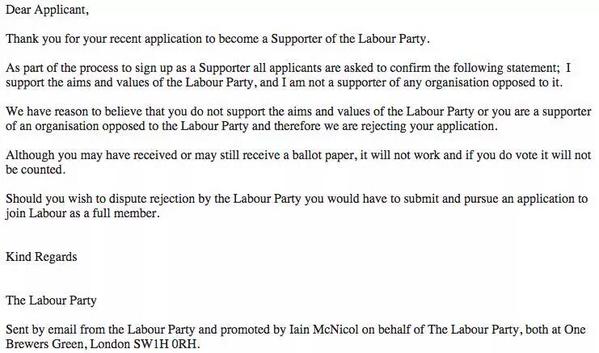
This is what is happening at the moment. Social media is awash with stories of left-wingers having their applications for supporter status, or even membership, refused. People who campaigned for Labour in May have been turned down, as have some who have gone to the super-rogatory extreme of attending CLP meetings. Attempting to defend the purge, right-wingers make vague noises about people "campaigning against Labour", a charge that often seems to amount to little more than having tweeted something unfavourable about the party leadership. In some cases the grounds are even weaker:
The right is actively soliciting the details of people which it thinks it can get away with barring from voting:


The catch-all email sent out to the purged states that the Party has "reason to believe" they do not share Labour values. In many cases, people have interpreted this as meaning that they have supported non-Labour candidates, however much in the distant past that may have been. One notes that a similar rationale isn't applied to floor-crossing Tory MPs, whom Labour has always greeted with open arms. Nor were the membership applications of scores of ex-SDPers, some of them central to the Blair project, at least one of them (Polly Toynbee) a very active anti-Corbynite at the present moment, who have joined since the Blair years.

The Blairites are in full counter-attack. The left must stand our ground; so much is at stake. If you have been purged, don't just drift off in a sulk: that is the intended effect of this. Challenge it, make a noise about it, and register your details here.

The best form of defence, of course is attack. And if nothing else, the events of the past few days should convince us that winning the leadership is not enough. To undo the Blair project, we have to oust it from CLPs, the party machine, and the PLP. The CLP left, dormant for far too long, has to wake up, contest positions and vote in trigger ballots. It's not always clear to me that the need for this kind of action - which will inevitably be pretty tough and uncomfortable - at times has sunk in. There is a lot of talk at the moment about consensus building. This is no doubt well-intentioned, but seems to be grounded in an out-of-date analysis of where the Labour left is at: the Corbyn surge renders the project of winning the hearts and minds of a shrinking Labour centre irrelevant, for the time being at least.The sad truth is that consensus is not always possible. Two utterly incompatible visions for the labour movement are coming head to head. And one of them must lose.


Wednesday, 24 June 2015

The heart and the head


Talking to people about the Labour leadership election, a recurrent theme can be summed up as follows: "I'd love to support Jeremy; he's a great guy and I agree with his ideas. But realistically Labour won't win with him in charge, and the most important thing is beating the Tories in 2020". The heart says Corbyn, the head says Kendall.

The thought here seems to be that 'the public' won't accept a Labour Party led from the left. Raymond Williams once observed that there are no such things as masses, only ways of viewing people as masses, and much the same could be said about publics. The public -- this seething undifferentiated mass of reaction -- only exists in the minds of commentators and second-rate sociologists. Utterly staid in its thinking it selects between election candidates like a cliched British tourist abroad choosing from a menu. Unmoved by the prospect of exotic dishes, it maintains a studied indifference between egg and chips and ham and chips. For this way of looking at things, Jeremy Corbyn is the tabbouleh of the leadership context. Activists are not part of the public, on this account, nor are the five million voters lost by Labour since 1997. For that matter, the entire Scottish nation is dubiously public. In fact, the public turns out to look very much like a Progress intern's stereotype of a swing voter in a southern English marginal. It's a rather deflating take on the British population.

Crucial to the head versus heart move is an image of the electorate as passive consumers of political programmes. They are not capable of being convinced, persuaded by argument, inspired by campaigns, or transformed by struggle. If 'the public' thinks x then the only response of a serious politician is to find ways of delivering x to the public. Electoral politics becomes a perpetual sales pitch, a transformation describable in two words: 'New Labour'. Of course, the customer is always right only within limits. To misquote a misquotation of Henry Ford, she can have any colour she likes as long as it's blue. Should she have the audacity to believe in the nationalisation of the railways, as a majority of the British electorate do, she should be kindly ignored and directed towards other political wares. The politics of appeal to 'the public' has always been in fact about the creation of the public, their desires and their perception of political posibilities, by a nexus of media and politicians. It is like a worked example in the theory of ideology.

In any case, it's not as though an alternative way of doing things weren't staring us all in the face; if only mainstream political geography didn't stop at Alnwick. The fact that the SNP won an election in Scotland on the basis of an anti-austerity ticket whilst refusing to join in the mainstream assault on migrants (supposedly a practically inevitable bowing to the 'legitimate concerns' of the public), cannot be explained by Scots being somehow magically more left-wing than the rest of the UK's population (even though some Scottish nationalists and the odd jaded English leftist seem to think this is the case). There is racism in Scotland just as there is England. It's just that a party decided to say something different, to challenge that racism. It didn't, it is fair to say, obviously suffer at the polls as a consequence. And - who knows - some of the public may have changed their minds as a result of exposure to an alternative narrative.

But what if the nay-sayers are right? What if a Corbyn-led Labour Party would be un-electable? I'm reminded here of some words of Tony Benn's,

In Labour Governments we did our best to make capitalism work in a civilised way. And we failed. It never can work. It will always exploit and oppress people.

Those who think that the programme of  a Cooper, a Burnham, or -- heaven forbid -- a Kendall could ever be a sufficient balm for humanity's wound could remedy this by watching the news, or even by leaving their house occasionally. The homeless on our streets, to whom we have disgustingly become accustomed as though they were part of the scenery, as natural as the trees; the lives eeked out in poverty; the migrants dying in the sea; the creativity and talent sucked dry in jobs with no social purpose beyond the production of profit; the accelerating destruction of the environment -- these are not ills that can be set right by a little tinkering with the system here and there. The only strategy  that stands a chance of addressing them -- let alone the context of international injustice and inequality within which they sit -- is a socialist and internationalist one. Jeremy Corbyn at least begins to understand this.

For that reason alone -- for the hard-nosed pragmatic reason that only Corbyn sees the world as it is and recognises the immensity of transformation we need -- Jeremy deserves your vote. He is, contrary to the received wisdom, the only realist amongst the line-up. Because this is about so much more than 2020. This is about the future, about hope, and about socialism. It is the politics of the heart and of the head.

Sunday, 7 June 2015

#Jeremy4Leader


This blog has taken a bit of a gloomy turn of late. I make no apologies for that. Things are rubbish, and a first step towards changing that is to see things clearly as they are. There's too much facile optimism on the left.

That said, it's nice to have something political to feel enthusiastic about. Jeremy Corbyn's candidacy for the leadership of the Labour Party is just this. It deserves your wholehearted support.

As I've said before, what we need is a counter-hegemony, challenging the austerity mindset that pervades our society. Jeremy's campaign is a chance to get alternative ideas out there and to challenge the consensus across all the main parties in favour of neo-liberalism. This is about much more than the leadership of the Labour Party, it is about our capacity to imagine another world.

It would obviously be very good indeed if Jeremy's name ended up on the ballot paper. For this to happen he needs nominations from Labour MPs. With this in mind - please pick a few MPs to email. Even people who are not natural left-wingers are worth targeting; argue that it would be good for the Party to have a proper debate about its future direction, and that this requires that Jeremy be on the ballot. An MP nominating him doesn't commit that MP to voting for him. Numerous MPs, including David Miliband, nominated Diane Abbott for the leadership in 2010 but didn't go on to vote for her.

If you're stuck about what to write, here's a sample letter from the excellent Red Labour.


Dear ___________
I am writing to you regarding Jeremy Corbyn’s decision to seek nomination for the Labour Party leadership. Jeremy’s announcement has undoubtedly electrified the leadership race. In the first 24 hours, he managed to secure the nominations of ten MPs, 2,800 people signed an online petition asking Labour MPs to nominate him and an incredible 10,000 people ‘liked’ the Facebook group ‘Jeremy Corbyn for Labour Leader’, more than all the other candidates put together. This is a clear indication that there is a thirst for a real debate amongst grassroots Labour Party members. It is now in Labour MP’s hands whether that debate takes place, or whether we have a leadership election where large swathes of our membership feels unrepresented and ignored.
As has been witnessed already, an election where the candidates broadly agree on the main issues only increases the public’s cynicism for the political process. It casts the Labour Party in a bad light after the shock of the general election not to be seriously discussing the issues raised by that defeat. For that honest, serious debate to happen, it is vital that Labour Party members, supporters and affiliates are be able to pick from a broad range of candidates representing the full range of opinion within our party. Jeremy will stand on a platform against austerity and in favour of a democratic economy which provides housing and services for all, while arguing for a fair immigration system and in favour of nuclear disarmament and humanitarian foreign policy. On those issues, Jeremy speaks for a substantial section of the grassroots of the party. If Jeremy is unable to overcome the substantial barrier to entry and make it on to the ballot, then we will not get that choice and the quality of the debate will suffer as a result.
It is in all of our interests to have an open and extensive leadership debate, one which is about the future of our party and how we move forward, stronger together towards the next General Election in 2020. Whether Jeremy is your preferred candidate or not, there is an overwhelming case for including a voice like his in this leadership contest. At this stage, it is not necessarily about who you are voting for - and we saw in the 2010 race how many MPs ‘lent’ their nominations to candidates in order to ensure a proper debate. That can be explained to both the candidate you intended to nominate and the wider electorate. In doing so, you will be putting the future of the party at the top of your list of priorities.
If you agree with me that a serious debate is needed and are able to offer your support to Jeremy’s campaign, I would very much appreciate it if you could let me know and cc in info@jeremyforlabour.com
Yours sincerely,


And if you want to be able to vote in the leadership election, become a Labour member or supporter. It only costs a few quid.